
 | 6000 Years and One Family | Amino Acids and Proteins Part 2 |  |
Amino Acids and Proteins Part 1
Posted on: 14 January 2026 by Andrew Perry
Posted in: [Creation]
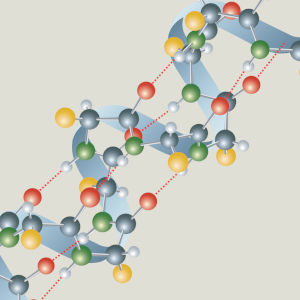
We have all heard of proteins, at least in the context of food and nutrition, but what actually is a protein? Proteins are one of the basic building blocks of living things. They are made up from large complex molecules and come in many different varieties, each one of which is designed to perform a unique function. Much of the infrastructure that makes up body tissue is constructed from proteins. Other uses include their role in substances such as enzymes which catalyse biochemical reactions, antibodies which fight infection, hormones which control body functions, and haemoglobin which is used to carry oxygen around the blood - to name but a few.
In some earlier articles, we looked at DNA and how it is made up of a programmed sequence of four varieties of building blocks known as nucleic acids. A similar principle applies to proteins, being made up of building block molecules known as amino acids, of which 21 varieties are used in the construction of proteins.
(If you are interested in seeing what these all look like, then please go to this page to see photos of molecular models which I have built.)
I would like to make a couple of points here:
- It is possible to define molecular structures for a large number of possible amino acids, and as it happens, more than 500 have been discovered to exist in nature, and yet only 21 specific ones are employed as building blocks for proteins. These 21 amino acids vary in complexity, from glycine (the simplest) to tryptophan (the most complex).
- With the exception of glycine, each amino acid can exist in one of two mirror image forms. The picture below of alanine (the second simplest) illustrates this. Each amino acid has an L (left-handed - Latin laevus) and D (right-handed - Latin dexter) form, and yet it is exclusively the L-forms that are used in the construction of proteins.
(Please go to this post to watch Richard's video on the same subject.)
What should we say to all of this? We have 21 out of hundreds of possible amino acids, and each of these in only the L-form, being used in the building of proteins. This looks very much like a methodical act of selection, and as such, surely points to the work of an intelligent designer, rather that the product of a random evolutionary process.

| 6000 Years and One Family | Amino Acids and Proteins Part 2 | |