


 | The Atom | Programming with Precision |  |
The Cell
Posted on: 01 June 2024 by Andrew Perry
Posted in: [Creation]
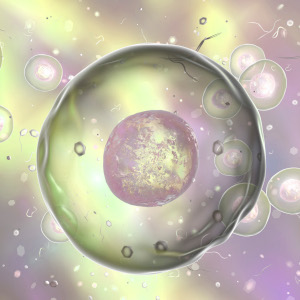
All living things are made up of building blocks known as cells. Some simpler life forms such as bacteria are only one cell in size, but more complex plants and animals are made up of a huge number of cells, often running into trillions. The following two pictures show simple schematic diagrams of plant and animal cells:


As you can see, a single cell has a variety of components, each one of which performs a particular function. Plant and animal cells are fundamentally similar in many ways, though there are certain key differences including:
- The outer membrane of a plant cell is surrounded by a rigid cell wall made of cellulose.
- Plant cells contain a component known as chloroplasts, which are responsible for carrying out photosynthesis (a major metabolic function of plants) and which give plant tissue its normal green colour.
We will not be going into any great detail here, but the main point to be made at this stage is that every individual cell is a complex piece of machinery with a variety of working parts which need to work in co-operation with one another. Here are a few examples showing the complexity of the cell and its functions:
- The infrastructure of any cell is built using large complex molecules such as carbohydrates and proteins. The exact molecular structure of everything has to be just right, in order for it all to hold and work together. Even the cell membrane has a complex structure facilitating its key role in the regulation of substances travelling in and out of the cell.
- We have already looked at DNA and its role in growth and reproduction in an earlier article. The main DNA set is stored in the cell’s nucleus, though smaller amounts are found in other components.
- Photosynthesis is the process used by plants, whereby carbon dioxide from the air is combined with water, and via a complex sequence of chemical reactions, is used to manufacture carbohydrates.
- Respiration is the process used by both plants and animals in which oxygen is combined with carbohydrates via a complex sequence of chemical reactions, used to generate energy, producing water and carbon dioxide as its by-products.
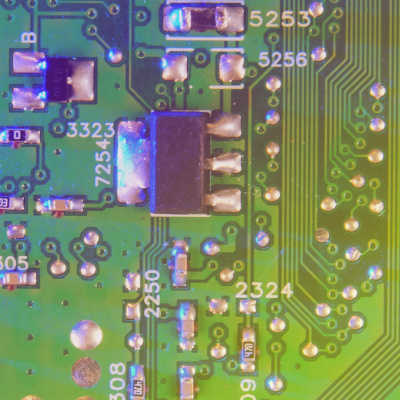
Now take the following image of a piece of computer electronics:

In some ways this can be compared to a biological cell, in that it contains a variety of components, all of which must work together in perfect co-operation. Even the microchip (which you can see near the centre of the image) is itself an electronic system made up of multiple components. It has taken human intelligence and the benefits of modern technology to design and achieve such things. Every component has an exact specification, and if one of these were to be changed, even slightly, then there is a good chance that the whole thing will cease to function properly.
I think it would be fair to say that the biological cell is a far more wonderful piece of engineering than any electronic circuit board. As in previous articles, this once again begs the question as to whether we are looking at a random evolutionary process or the work of intelligent design and a creator God.
| The Atom | Programming with Precision | |