


 | The Eye | The Cell |  |
The Atom
Posted on: 12 May 2024 by Andrew Perry
Posted in: [Creation]
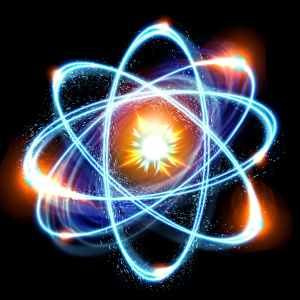
Most of us are familiar with the idea that all matter is made up of tiny atoms. In fact they are so small that a single atom has a diameter of approximately 0.2 nanometres (that is to say a 5 millionth of a millimetre). The atom itself is however made up of smaller particles, of which there are three basic types (not to mention that there is evidence that these can be sub-divided further, though we won’t go there at the moment).
The main particles that make up an atom are protons, neutrons and electrons. You have probably heard these words even if you don’t know exactly what they are. Protons and neutrons are the same size and weight as one another, each one weighing approximately a 600 sextillionth of a gram. A proton carries a positive electrical charge whilst a neutron carries no electrical charge. A electron is nearly 2000 times smaller than a proton or neutron and carries a negative electrical charge that is equal and opposite to that of a proton. Within an atom, the protons and neutrons are gathered together in the centre to form a nucleus, while the electrons orbit around, a bit like planets in a solar system.
An atom always contains an equal number of protons and electrons, thus giving it an overall neutral charge. The number of proton/electron pairs in an atom determines the chemical element to which the atom belongs, an element being a basic substance that goes into the making of matter. So for example, hydrogen has 1 proton/electron pair, carbon has 6, nitrogen 7, oxygen 8 and so on. Matter is made by the bonding of atoms together to form molecules or larger structures. A simple well known example is that of the combination of two hydrogen atoms and one oxygen atom to form a molecule of water (H2O).
In recent articles we have looked at some of the advanced precision engineering that goes into the creation of biological systems. When we go down to the atomic and sub-atomic levels we see exactly the same thing, as an atom is a very precise piece of machinery. For atoms to hold together and to bond correctly with each other to form substances, the sizes, weights and electrical charge intensities of the sub-atomic particles have to be in exactly the right proportions in relation to one another – if any of these were to change, everything would just collapse or fall apart.
Once again this has surely got to be the work of a Creator God, and perhaps the following verse of Scripture sums it up:
He is before all things and in him all things hold together. (Colossians 1:17 NIV)
| The Eye | The Cell | |