


 | Amino Acids and Proteins Part 1 |  |
Amino Acids and Proteins Part 2
Posted on: 21 July 2026 by Andrew Perry
Posted in: [Creation]
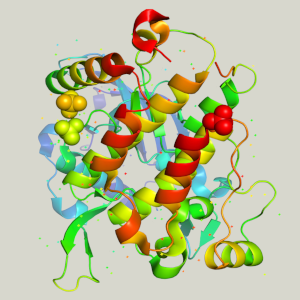
In the previous post, we started to look at amino acids and proteins, and the way in which proteins are built from a programmed sequence of amino acids, of which 21 different varieties are used. Having said that however, there is far more to the structure of a protein than the actual sequence of amino acids. We need to take into account the huge number of functions that proteins perform, of which some key categories are:-
- Infrastructure - Proteins are essential for providing physical structure to cells and other tissue material.
- Enzymes - These catalyse (i.e. assist or speed up) chemical reactions in the body, such the digestion of food.
- Defence and Immunity - Antibodies protect against disease by attacking foreign bodies such as viruses.
- Hormones - These are responsible for signalling and the co-ordination of various bodily functions.
- Storage & Transportation- Proteins are responsible for storing nutrients or for transportation of substances, either around the body or in and out of cells. A well know example is haemoglobin, which carries oxygen through the bloodstream.
- Detection and Signalling - Proteins are used to detect various signals (e.g. the presence of hormones or sensory stimuli), passing the required communications to cells.
- Motor Energy - Proteins are used in converting nutritional (chemical) energy into physical energy such muscle contraction.
- Gene Control - Although all cells contain a full copy of the genetic code, individual genes are turned on of off according to the functional requirements of a given cell. This is a highly complex process, and proteins are essential in the control of such functions.
Every individual protein requires its own individual shape in order to correctly perform its particular function. For example, a protein providing infrastructure will need to be configured into chains or sheets. On the other, hand a protein requiring mobility will need to be curled up into a globular structure in order to float and move. Also it will need to fit like a jigsaw piece to something with which it is interacting (e.g. an enzyme connecting to part of a chemical reaction, or an antibody connecting to a specific virus). Four broad levels of configuration are defined:
- Primary Structure - This defines the sequence of amino acids that make up the molecular chain of the protein. A working protein will not remain with only a primary structure. Because various parts of an amino acid molecule will attract/repel other parts of amino acids and will also attract/repel water, an amino acid chain will automatically bend into a particular configuration. This happens in a repeatable way, completely determined by the raw amino acid sequence.
- Secondary Structure - At the next level of configuration, an amino acid chain will configure itself into a helical coil, or amino acid chains will bond together side by side to create what is know as a pleated sheet.
- Tertiary Structure - Proteins requiring a more globular structure will then undergo a further level or configuration in which the secondary structure bends and curls in a specific way, to create a fully predictable configuration.
- Quarternary Structure - In some cases, tertiary structures will come together in a particular way to create multi-molecular superstructures.
The complexity and precision of all of this, is totally amazing and almost beyond simple comprehension, again surely the work of an intelligent designer!
| Amino Acids and Proteins Part 1 | |